What's new
A better Clareza, for every kind of learner
This fall we rebuilt a lot of Clareza around one question: what actually helps a child learn? Here is what changed.
Learning Supports: tell us what helps, and every lesson adjusts
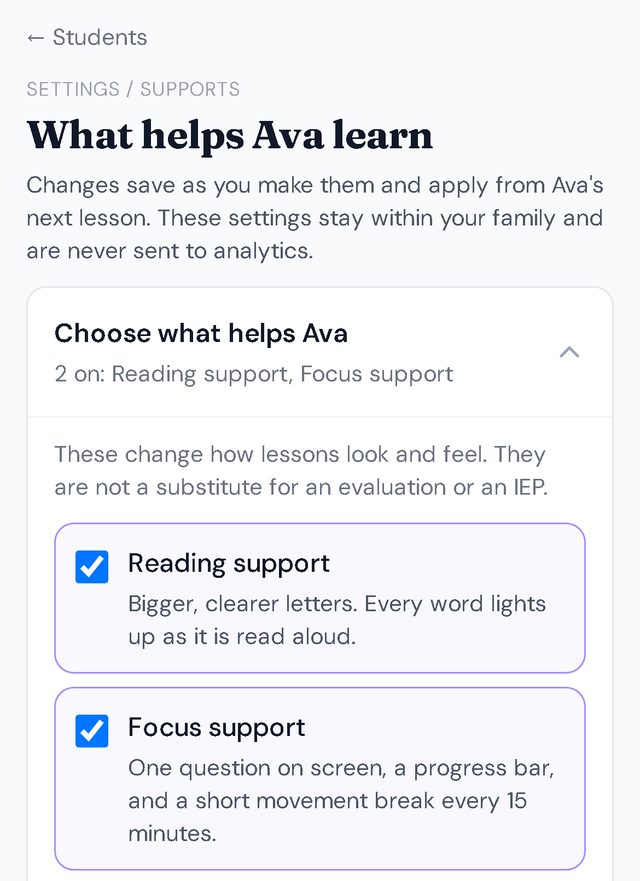
On your Students page, choose what helps each child. Lessons, practice and Clara change to match. You choose switches, never labels, and we never ask for a diagnosis.
- Reading support: everything read aloud with each word highlighted, an easier font, plain literal wording, answer by tapping or out loud.
- Focus support: focus mode, shorter lessons, movement breaks.
- Predictable routine: the same layout every time and a heads-up before anything changes.
- Math support: pictures for every problem, number lines, ten-frames, fraction strips, a calculator when it helps.
- Writing support: sentence starters and organizers, and ideas count more than spelling.
- Low-pressure mode: no timers, no scores on screen, gentle feedback, try again without penalty.
Clara can show, not just tell
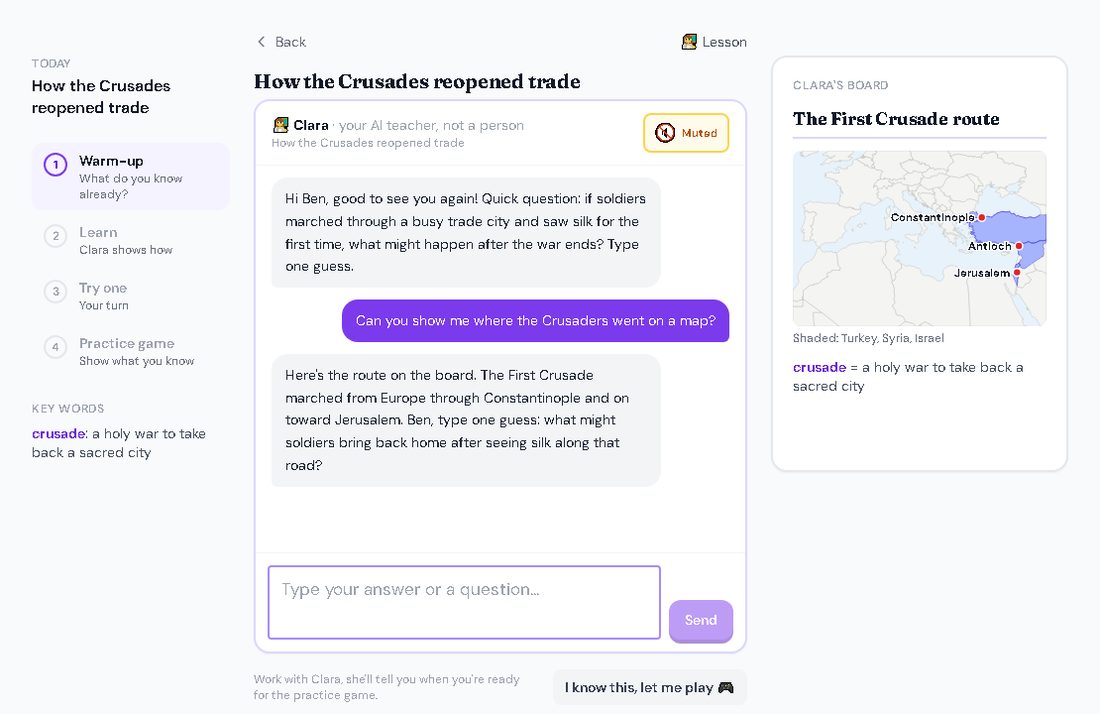
On a computer, Clara now writes on a whiteboard beside the chat: key words, steps, real maps with the places she is talking about, and public-domain artwork for art and history lessons. Ask her “can you show me?” and she will.
Every lesson stands on its own
We checked all 4,294 lessons and fixed more than 11,000 places where a lesson referred to a reading, picture or map that was not on the screen. Today, when a lesson says “read this”, the passage is right there.
Two of the real fixes, word for word:
Before: A student claims: 'The narrator says everything's fine, so the mood of this passage is calm.' Explain what's wrong with this claim using the passage above. (There was no passage above.)
Now: Here is the passage again: “What a lovely little outing, I thought, as we filed past the boarded windows and the dogs stopped barking one by one...” A student claims: 'The narrator says everything's fine, so the mood of this passage is calm.' Explain what's wrong with this claim.
Before: A student sees Virginia on the map. Is Virginia in the Southeast region? (There was no map.)
Now: Imagine a five-region map of the United States. Virginia is on the Atlantic coast, just north of North Carolina. Is Virginia in the Southeast region?
For our youngest learners
- Tap each object to count it, one by one, out loud.
- Real coins with their values, so a dime never looks like a nickel.
- Pictures that always match the numbers in the question.
- Say-it-out-loud cards with a microphone button, and a warmer, steadier voice for Clara.
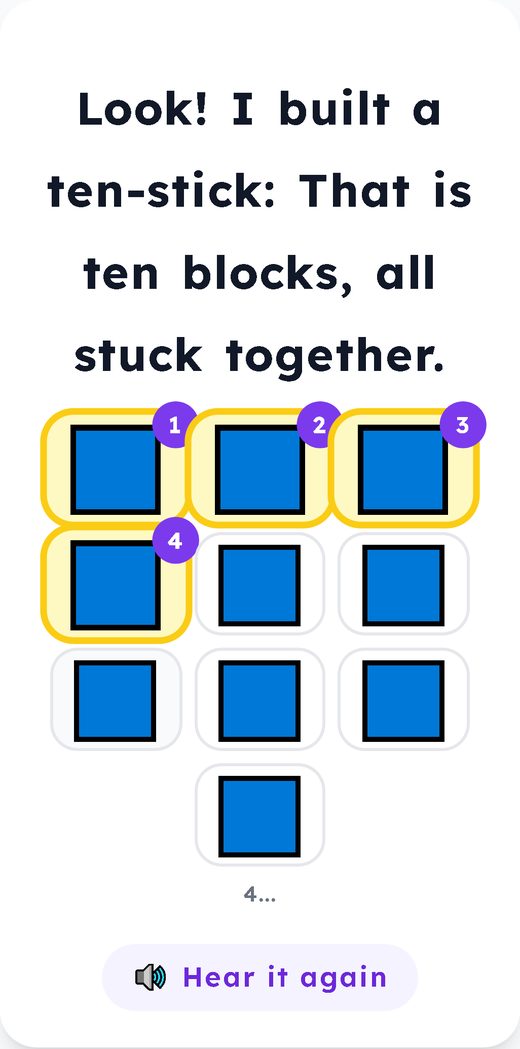
Hear Clara
Her real voice, exactly as children hear it.
Privacy, improved
When your child answers out loud, the audio is turned into text on our own server and then discarded. It is never sent to another company and never stored. Read our privacy policy.
Secular K-12, $29 a month for the whole family. Your first 30 days are free.